







What Should Buyers Consider When Sourcing Women’s Swimwear for Retail?
Release time: 2026-10-08
Table of Contents
For retailers, boutiques, and fashion brands, sourcing the right swimwear involves more than finding attractive products. A suitable collection needs to match the target customer, fit the store’s pricing strategy, and offer enough variety to support different shopping preferences. Buyers also need to consider product specifications, order quantities, customization options, and the supplier’s ability to meet their requirements.

Since 2009, EFIRSTY has focused on swimwear and activewear OEM production, providing services that cover product development, sourcing, and manufacturing. For businesses looking for women’s swimwear, understanding the following purchasing factors can help them build a more suitable product range and establish a reliable supply relationship.
1. Match the Product Range to Your Retail Customers
Before contacting a supplier, buyers should define the type of swimwear their customers are most likely to purchase. A boutique serving vacation travelers may prioritize fashionable bikinis, while a retailer with a broader customer base may need both two-piece and one-piece designs.
The product range includes different silhouettes, colors, patterns, and decorative details. For example, a collection may combine a solid-color one-piece swimsuit with printed or striped bikinis to offer customers different visual options.
Buyers should also consider the relationship between individual products. A coordinated collection can make it easier to present complementary designs in a seasonal catalog or retail display. Instead of ordering many similar items, retailers can select products that offer meaningful differences in appearance and style.
A clear product plan helps buyers communicate their requirements to a supplier and avoid unnecessary overlap within the collection.
2. Evaluate Swimwear Styles and Product Details
Product appearance plays an important role in retail purchasing decisions. Buyers should assess not only the overall silhouette but also the details that distinguish one product from another.
The women’s swimwear collection from EFIRSTY includes a variety of bikini and one-piece designs, with different colors, patterns, and decorative details to suit different retail collections.
- Bikini Sets: The collection includes two-piece bikini designs with different colors and styling details, giving retailers options for building a varied swimwear range.
- One-Piece Swimsuits: Solid-color one-piece designs offer an alternative to bikinis and can help retailers diversify their product selection.
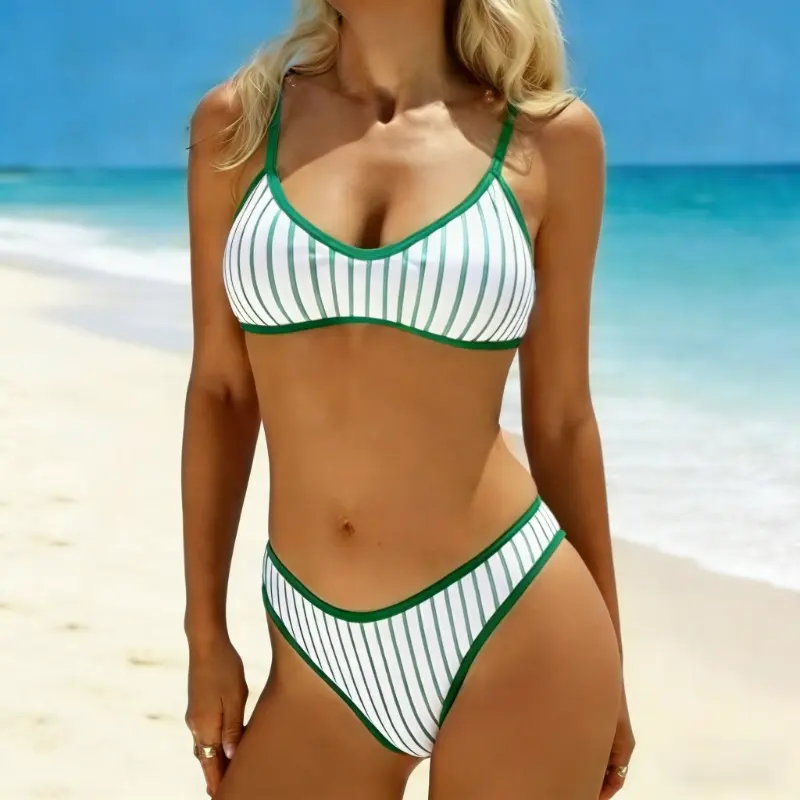
- Striped Swimwear: The emerald green striped bikini combines a distinctive color with a striped pattern, adding visual variety to a retail collection.
- Decorative Bikini Designs: The champagne-colored bandeau bikini features a gold-toned leaf accent, creating a distinctive detail without relying on an elaborate overall pattern.
- Custom-Logo Swimwear: Selected designs, including the emerald green striped bikini, support custom logo placement for brands developing their own swimwear collections.
When evaluating these products, buyers should consider how each design fits their target market, complements other items in the collection, and meets their branding requirements. For specific customization options, fabric details, and order conditions, buyers should confirm the available specifications with the supplier.
3. Check Fabric and Product Specifications Before Ordering
Fabric composition, garment construction, and sizing specifications should be confirmed before a purchase order is finalized. These details affect how a product is manufactured and help buyers establish clear expectations for the finished garments.
Retail buyers should ask suppliers to clarify the following information:
- Fabric composition and available color options
- Size range and measurement specifications
- Lining, padding, straps, and other construction details where applicable
- Print placement and decorative components
- Care instructions and product labeling requirements
The appropriate specifications depend on the selected design. For example, a bikini with decorative metal accents requires different detail checks from a simple solid-color one-piece swimsuit.
Buyers should also distinguish between advertised product features and confirmed specifications. If a particular fabric composition, performance characteristic, or construction detail is important to the order, it should be verified with the supplier rather than assumed from the product category.
Clear specifications reduce the risk of misunderstandings and provide a reference for sample approval and subsequent production.
4. Consider Customization for Private-Label Retail
For retailers developing their own brands, customization can help create a recognizable product range. Rather than purchasing only standard designs, buyers may want to discuss options for colors, prints, branding, and selected garment details.
A suitable women’s swimwear supplier should be able to explain which customization options are available for the chosen products and what information is needed to develop them.
For example, the emerald green striped bikini listed in the product range features custom-logo positioning. This provides a relevant starting point for buyers interested in branded swimwear. Other design requirements should be discussed individually, as customization availability may vary by product.
Before approving a customized order, buyers should confirm the logo artwork, placement, color requirements, size specifications, and any changes to the original design. A sample review can help establish whether the finished product matches the approved concept.
Retailers should also clarify whether customization affects minimum order quantities, pricing, sampling arrangements, or production schedules. These details are best confirmed before committing to the order.
5. Compare Suppliers Beyond the Quoted Price
Price matters in retail purchasing, but the lowest quotation does not necessarily represent the best overall value. Buyers should evaluate a supplier’s product range, communication, customization capabilities, and production arrangements alongside the quoted cost.
When assessing a potential women’s swimwear supplier, consider these questions:
Product range: Does the supplier offer enough relevant designs to support your planned collection?
Customization support: Can the supplier discuss your branding and product development requirements?
Specification management: Can the supplier confirm materials, measurements, and construction details before production?
Order flexibility: Can the supplier explain its minimum order quantities and whether smaller or staged orders are possible?
Production coordination: Are lead times, sample arrangements, packaging requirements, and delivery terms clearly communicated?
These questions help buyers compare suppliers on a consistent basis. They also make it easier to identify potential problems before an order enters production.
A useful quotation should clearly state what is included and identify any additional costs associated with customization, samples, packaging, or shipping.
6. Plan Order Quantities and Inventory Carefully
The quantity of each design should reflect the retailer’s sales plan, available storage, and budget. Ordering too many variations can increase inventory complexity, while concentrating the entire order on a single design may limit the collection’s appeal.
When planning wholesale women’s swimwear purchases, buyers should first identify the core products they want to stock. They can then decide how to distribute quantities across styles, colors, and sizes based on their target customers and sales strategy.
New designs may warrant a more cautious initial order if demand is uncertain. Established products with a reliable sales history may justify larger quantities, depending on the retailer’s inventory needs and supplier terms.
Buyers should confirm minimum order quantities at both the product and color levels. A supplier may apply different requirements to standard products and customized designs, so these conditions should not be assumed to be identical.
It is also worth discussing replenishment arrangements and the possibility of staged deliveries when planning seasonal inventory. Actual availability will depend on the supplier’s production schedule and agreed order conditions.
7. Review Samples and Confirm Production Requirements
Before placing a large order, buyers should establish how product samples will be reviewed and how the approved specifications will be documented.
Sample evaluation should focus on the details that matter for the selected design, including garment proportions, seam quality, material appearance, color consistency, logo placement, and the construction of decorative elements.
If adjustments are required, buyers should communicate them clearly and obtain confirmation before production proceeds. Keeping a record of the approved sample and final specifications gives both parties a common reference.
This step is especially important for customized products. Even a small change to a logo’s position, a garment’s proportions, or a decorative component may affect the finished appearance.
Buyers should also clarify how any requested changes may affect pricing and lead time. A well-defined approval process helps keep purchasing decisions aligned with production requirements.
8. Choose a Supplier That Fits Your Long-Term Business
A suitable supplier should offer more than individual products. For retailers planning to develop their swimwear business over several seasons, the ability to discuss new designs, customization, sourcing, and production arrangements can be equally important.
EFIRSTY has worked in swimwear and activewear OEM production since 2009. Its company information highlights more than 16 years of industry experience, over 15 new original designs each month, and production capacity across Cambodia, Myanmar, China, and Laos. The company also describes flexible arrangements for smaller quantities and multiple-batch deliveries.
For buyers, these capabilities provide useful starting points for a supplier discussion. Specific production locations, minimum quantities, lead times, and order arrangements should still be confirmed for each project.
The best sourcing decision is one that balances product suitability, commercial requirements, and the supplier’s actual capabilities. By defining their needs in advance and confirming the relevant details, retailers can make purchasing decisions with greater clarity.
Conclusion
Successful retail sourcing starts with a clear understanding of the target customer and the products the business wants to offer. Buyers should compare swimwear styles, confirm material and sizing specifications, evaluate customization options, and review order conditions before making a commitment.
Working with an experienced supplier can also make product development and purchasing coordination more straightforward. With its established swimwear and activewear OEM experience, EFIRSTY offers retailers and brands a range of women’s swimwear products and customization services to discuss when developing their next collection.
FAQs
1. What should retailers prioritize when sourcing women’s swimwear?
Retailers should consider their target customers, product styles, fabric specifications, size range, pricing requirements, and available customization options. Order quantities and delivery schedules should also fit their inventory plans.
2. What types of women’s swimwear can retailers source?
Common options include bikinis, one-piece swimsuits, striped designs, solid-color styles, and products with decorative details. The available selection depends on the supplier’s current product range.
3. Can buyers order wholesale women’s swimwear with custom logos?
Some swimwear products support logo customization. Buyers should confirm the available application methods, artwork requirements, minimum quantities, and any additional costs with the supplier.
4. Why should buyers review samples before bulk production?
Samples allow buyers to check the garment’s appearance, measurements, materials, stitching, and branding details before approving production. They also help establish a reference for the finished order.
5. How can retailers evaluate a women’s swimwear supplier?
Retailers can compare product variety, customization support, specification management, order flexibility, communication, and delivery arrangements. They should also confirm pricing, minimum order quantities, and production terms before placing an order.

